Real-World Evaluation
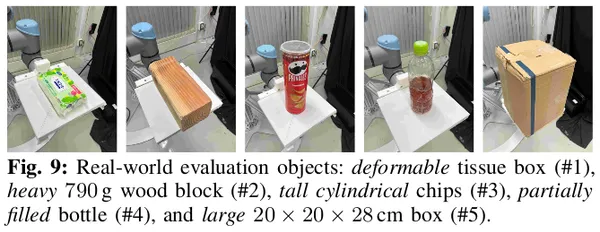
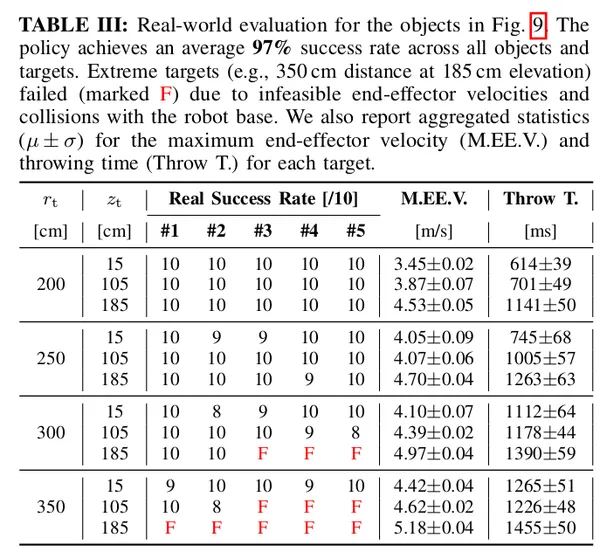
Across five objects and nine target positions, our policy achieved an average of 97% success rate.
IEEE International Conference on Intelligent Robots and Systems (IROS 2026)
*Corresponding Author: am-mustafa@aist.go.jp 1National Institute of Advanced Industrial Science and Technology (AIST), Japan 2Waseda University, Japan
TL;DR
We learn an offline planner for non-prehensile throwing trajectories via reinforcement learning.
We demonstrate the policy’s generalization, robustness, and its zero-shot sim-to-real transferability.
Robotic throwing enables fast object transport and extends a robot’s reachable workspace beyond traditional pick-and-place. While prehensile (grasp-based) throwing works well for graspable items, non-prehensile (grasp-free) throwing is better suited for large, heavy, and/or deformable objects. Existing approaches rely on model-based optimization with simplified contact models (e.g., dynamic grasping) and low-dimensional trajectory parameterizations, which limit solution quality and reachable workspace. We propose a reinforcement learning approach that additionally leverages sliding and rolling contact modes and directly optimizes joint-space trajectories without ana- lytical contact models or custom parameterizations. The Markov Decision Process (MDP) is formulated as a dynamical system that evolves the robot’s joint state conditioned on the throwing target, object model, and initial configuration. Joint-jerk trajectories are planned offline at a low control rate and upsampled into smooth, high-rate velocity commands for deployment. For sim-to-real transfer, we minimize the robot-dynamics gap through minimum- jerk system identification and train uncertainty-aware policies to mitigate object-modeling errors, particularly sensitivity to dynamic friction. In simulation, the policy achieves 99% success across thousands of configurations and generalizes to unseen objects. Sensitivity analysis shows robustness to mass uncertainty but high sensitivity to dynamic friction, consistent with the sliding-based release mechanism. Deployed zero-shot on a UR5e operating near its physical limits (5 m/s end-effector velocity), our method throws diverse objects—including heavy (790 g) and large (20 × 20 × 28 cm) items—to targets up to 350 cm distance or 180 cm elevation, achieving a 97% real-world success rate.
We test NP-Throw’s robustness by applying trajectories optimized for the “Wood Block” to other objects. The policy maintains high success rates, showing robustness to mass and size variations. It can also be used for multi-object throwing.
    @inproceedings{NP_Throw_IROS2026,
  title = "Non-Prehensile Throwing: A Reinforcement Learning Perspective",
  author = "{Abdullah Mustafa, Ryo Hanai, Ixchel Ramirez, Floris Erich, Ryoichi Nakajo, Yukiyasu Domae, Tetsuya Ogata}",
  booktitle={IROS 2026},
  year={2026},
  organization={IEEE}
}